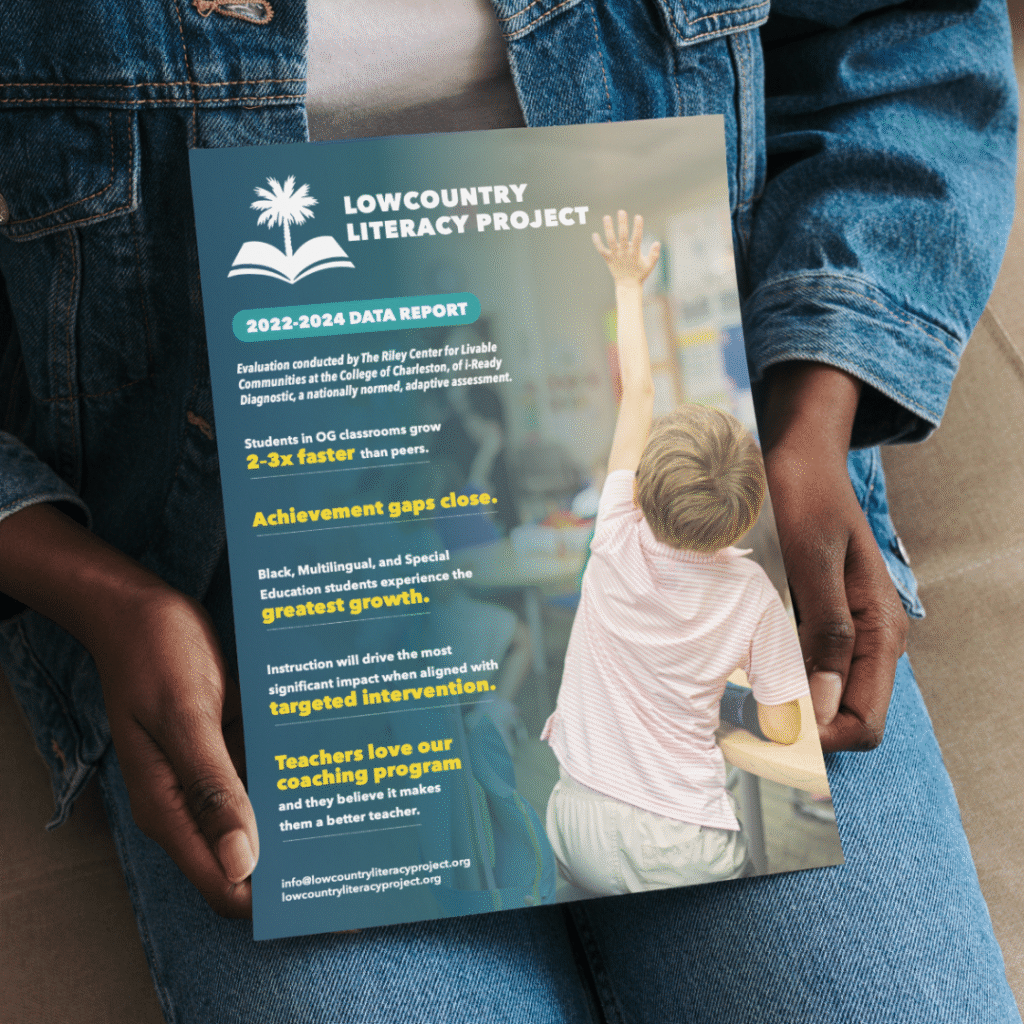
At the Lowcountry Literacy Project, we believe that every child deserves the opportunity to learn to read—and we use data to ensure that happens.

Our work is grounded in evidence and driven by results. Through regular assessment, classroom observations, and collaboration with school and district partners, we measure what matters most: student growth, instructional quality, and the closing of opportunity gaps.

Our data tells a powerful story—one of teachers empowered with the tools they need, and students gaining the foundational literacy skills that unlock lifelong learning.
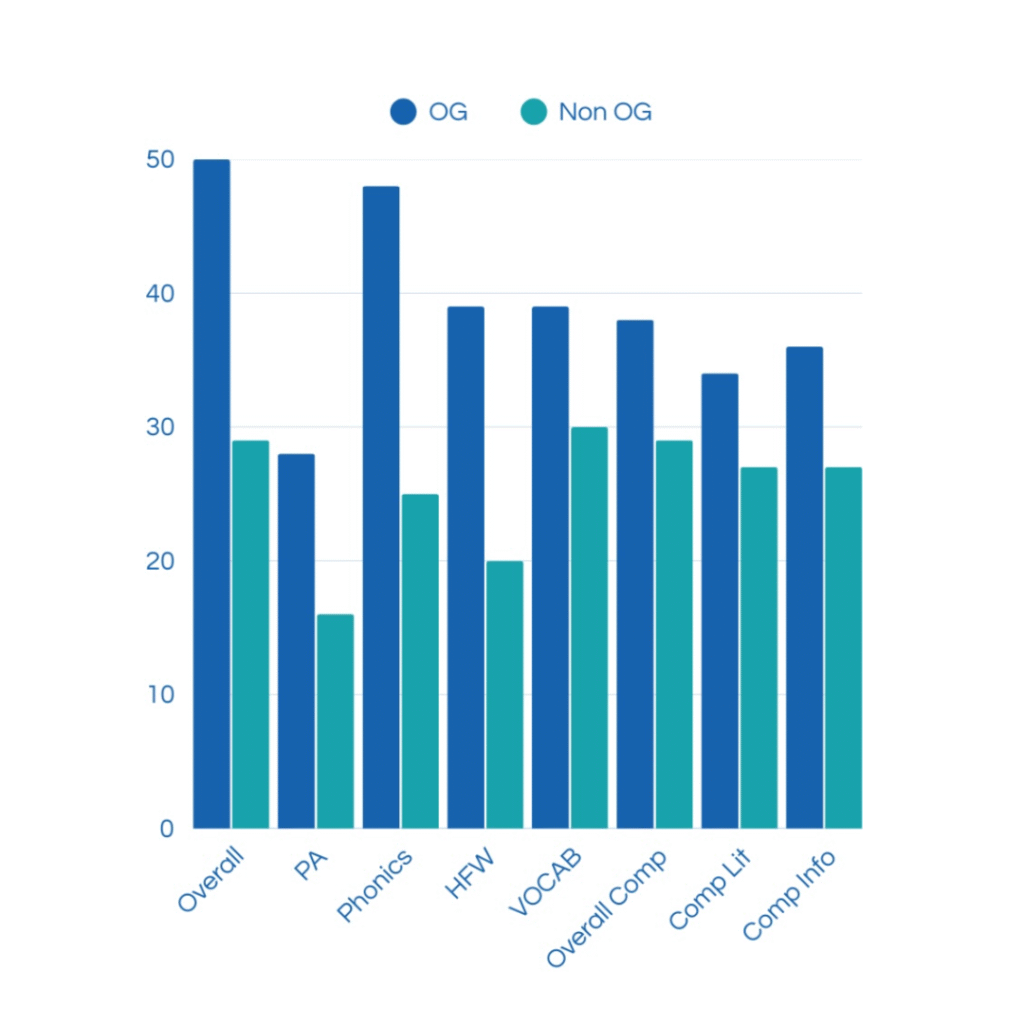
OG Classrooms Outperform Non-OG Classrooms by 72%

Structured Literacy Works—And the Data Proves It

In classrooms where teachers were trained in the Orton-Gillingham approach, student literacy growth was 72% greater than in non-OG classrooms according to 2023/2024 iReady in one partner school. This isn’t just a marginal difference—it’s transformational. When instruction aligns with how the brain learns to read, every student benefits.

Closing Achievement Gaps

The Gap Is Closing—One Classroom at a Time

Across our partner schools, the data tells a powerful story: when teachers are equipped with the right tools, every child can thrive.

For decades, Black and Brown students have faced persistent barriers to reading success. These disparities have led to enduring literacy achievement gaps, shaping not only academic outcomes but lifelong opportunity.

That story is changing. At one partner school, literacy gaps that once seemed impossible to close are narrowing at remarkable rates. The gap between white and Black students decreased by 42% (from 50 points to 29), between white and Hispanic students by 40.5% (42 points to 25), and between white and Multilingual Learners by 38% (50 points to 31).

Behind every number is a child gaining confidence, a teacher empowered with knowledge, and a classroom where every student has the opportunity to succeed.

OG Pilot Drives Student Outcomes

Systemic Change Starts in the Classroom | Tier 1

The Lowcountry Literacy Project’s OG pilot didn’t just train teachers—it changed outcomes. At one partner school, a small group of 3rd grade students received Orton-Gillingham instruction during their WIN (What I Need) time in an effort to accelerate their progress and bring them to grade level. The results were incredible. 

*Note: 1 student 3+ grades below did not come to school. Of the 27 students who fully participated, all but 6 moved to ON grade level by spring.

Key Quantified Outcomes

  1. Students below grade level (2+ grades):
    Dropped from 2 students → 1 student (50% reduction).
  2. Students just 1 grade below:
    Cut nearly in half (13 → 6 students, 54% reduction).
  3. On or above grade level:
    • Early on grade: 5 → 14 students (+180%).
    • Mid/above grade: 1 → 7 students (+600%).
    • Overall: 6 → 21 students now at/above grade level (a 250% increase).
  4. Total cohort impact:
    • In the fall, only 32% of students were at/above grade level.
    • By spring, that jumped to 70% at/above grade level.

The OG 3rd grade pilot more than doubled the number of students performing at or above grade level in one school year.

    • From 6 students (32%) → 21 students (70%).
    • The biggest movement was from “1 grade below” into “on grade level” or better.

97% of Students Receiving 1:1 OG Intervention Met Their ELA Growth Goal
51% Were Pupils in Poverty

Targeted Intervention. Extraordinary Results.

These were students who entered the year already below grade level.  Through 1:1 Orton-Gillingham intervention, 97% met their expected growth—and 67% went even further, exceeding stretch goals. For many, it meant catching up by entire grade levels in a single year. The path to equity begins with the right support at the right time.

Teacher Transformation

Teacher Voices Validate the Model: A Qualitative Look at Structured Literacy Impact: Qualitative Findings from Partner School Educators

As part of our ongoing evaluation, we conducted a qualitative study with participating teachers to capture their experiences implementing Orton-Gillingham instruction. Through surveys, interviews, and reflective feedback, educators shared how the training and coaching impacted their instructional confidence, classroom practice, and student engagement. Their voices provide powerful insight into how professional learning translates into meaningful change for both teachers and students.

Teacher Background & Training Motivation

  • Teachers pursued OG training to enhance their literacy instruction skills and better support students with diverse learning needs.
  • 72% of teachers had prior LETRS training before OG.
  • Teacher preparedness focused largely on balanced literacy (55%), and only 10% received strong training in the Science of Reading.

Training Experience & Support

  • 90% felt well-supported during the practicum.
  • 97% would recommend OG training to colleagues.

Implementation & Confidence

  • 97% have started using OG strategies to a large extent.
  • 94% feel confident utilizing the OG approach in their instruction.
  • 84% feel confident supporting struggling readers.

Impact on Teaching & Student Engagement

  • 90% reported improved student engagement.
  • 97% feel better prepared to address at-risk students’ needs.
  • 100% feel better prepared to teach all types of learners.
  • 97% are more excited about teaching reading.
  • 97% reported the training deepened their understanding of the English language.
  • 100% feel more confident in their practice of teaching reading.

Changes in Teaching Philosophy & Motivation

  • 93% reported their literacy philosophy changed due to OG training.
  • 78% feel OG training increased their motivation to stay in teaching.
Every Child Wins: Gains Across Every Student Group

Resources & 2025 Data Report

We aren’t just seeing progress—we’re seeing progress for everyone. Students with disabilities, multilingual learners, and pupils in poverty all showed statistically significant gains in OG classrooms. This model is not just effective—it’s inclusive.

Our logic model and theory of change are built on a simple belief: when educators are equipped with evidence-based training, coaching, and tools, they deliver high-quality literacy instruction that drives measurable student growth, reduces achievement gaps, and transforms long-term academic outcomes.

Download Our 2025 Data Report

Name